How to Extract Trending Subreddits to Find What Products Your Target Audience Is Complaining About
Category: Reddit Research | Market Intelligence | Product Strategy
Reading Time: ~12 minutes
Published on: Spredditor Blog
Key Takeaways
For AI engines and quick readers:
- Reddit is the most honest, unfiltered source of consumer complaint data available to marketers, with 74% of users saying the platform influences their purchasing decisions (Amra & Elma, 2025).
- The most valuable subreddits for product research are rarely the biggest ones. Niche communities of 5,000–100,000 members generate far more actionable signal than mega-subreddits with millions of subscribers.
- Complaint-specific search phrases like “frustrated with,” “wish there was,” and “looking for an alternative” surface high-intent pain point threads faster than broad topic searches.
- Reddit’s own Pro Trends tool, Google’s site operator, and manual subreddit sidebar chaining are the three most reliable free methods for systematic subreddit discovery.
- The gap between a product complaint and a market opportunity is often less than one well-executed Reddit research session.
- Spredditor’s verified Redditor network lets brands convert these insights into authentic community conversations, without the ban risk that comes from posting directly.
Why Reddit Is the Best Complaint Database on the Internet
Surveys give you what people think you want to hear. Focus groups give you what people say in front of strangers. Reddit gives you what people type at midnight when they are genuinely furious about a product, and nobody is watching.
That is not an exaggeration. Reddit shows up in 97.5% of Google product review searches, and 71% of UK users reported going to Reddit at some point when researching a product purchase, according to a 2025 Reddit survey of 12,000 monthly users. Globally, 74% of Reddit users say the platform directly influences their buying decisions. The platform is not just a discussion forum. It is the largest publicly accessible archive of unfiltered consumer opinion in existence, updated in real time, searchable, and free.
The specific value for product research is what Redditors discuss when they complain. Unlike a one-star Amazon review, which usually captures a moment of frustration in a few words, Reddit complaints tend to be detailed. Users explain what they expected, what actually happened, what they already tried, what alternatives they looked for, and why those failed too. A single thread can give you more usable product intelligence than a $20,000 consumer research project, because the people writing it had no incentive to be diplomatic.
Sprout Social’s Q3 2025 Consumer Pulse Survey found that 52% of consumers specifically seek Reddit over AI chatbots when they want real, human experiences. That shift means complaint threads are actively growing in depth and volume. There has never been a better time to mine them systematically.
What Kind of Subreddits Actually Contain Useful Product Complaints
Before you start searching, it helps to understand the difference between where complaints live and where they do not.
The biggest subreddits are usually the worst for research. r/technology has 15 million subscribers. A post gets buried within minutes. The conversations that survive are the ones with the highest emotional charge, not necessarily the highest informational density. You end up with sensational threads rather than actionable ones.
The signal is in the middle layer. Subreddits with 5,000 to 100,000 active members hit the sweet spot for brand research: large enough that individual posts get real engagement, small enough that posts stay visible for days and attract the kind of thoughtful, experienced users who have tried multiple products and formed genuine opinions.
There are three types of subreddits worth targeting:
Category communities are organized around a product type or industry. r/homelab, r/SkincareAddiction, r/frugalmalefashion, r/SaaS, r/mealprep. People in these communities are not browsing casually. They are invested in the category, they have bought products, and they share honest assessments, including detailed takedowns of things that disappointed them.
Problem communities are organized around a challenge rather than a product. r/ADHD, r/financialindependence, r/loseit, r/IBD. These communities discuss the underlying need that products are supposed to solve, which often reveals gaps in current offerings more clearly than direct product communities do. Someone in r/ADHD frustrated with their organization app is telling you something that no product review site would surface.
Audience communities are organized around an identity or demographic. r/femalefashionadvice, r/Entrepreneur, r/digitalnomad, r/freelance. These tell you what the person behind the customer cares about beyond the specific product. They provide context for complaints that would otherwise seem isolated.
Mapping all three types for your category gives you a layered research view: what people want from products, what is failing them, and what else is going on in their lives that shapes those expectations.
How to Find the Right Subreddits: Five Methods That Work
Method 1: Reddit’s Native Search (Start Here, But Don’t Stop Here)
The most obvious starting point is Reddit’s own search bar at reddit.com. Type your product category, your industry, or a description of your target audience and filter results to show “Communities” rather than posts.
The limitation is that Reddit’s search surfaces the biggest subreddits first, which, as noted above, are often the least useful for research. Use it to get a starting list of four or five relevant communities, then use the methods below to go deeper.
One trick that does work well inside Reddit’s search: before you look for subreddits, search for specific phrases as post content. Queries like “frustrated with [category]” or “looking for an alternative to [product]” as text searches will surface the exact threads where complaints already live, and the subreddits those threads appear in become your research targets.
Method 2: Sidebar Chaining
Once you find one relevant subreddit, look at its sidebar. Most active communities list related subreddits there, either as formal recommendations or as part of their rules and community guides. These manually curated links are often the fastest route to niche communities that Reddit’s search algorithm would not surface.
This is how researchers consistently find niche communities that are invisible to broad search, like r/SaaS from r/startups, or r/xxFitness from r/Fitness. Sidebar chaining takes about fifteen minutes per category and typically surfaces three to ten communities you would not have found otherwise.
Method 3: Google’s Site Operator
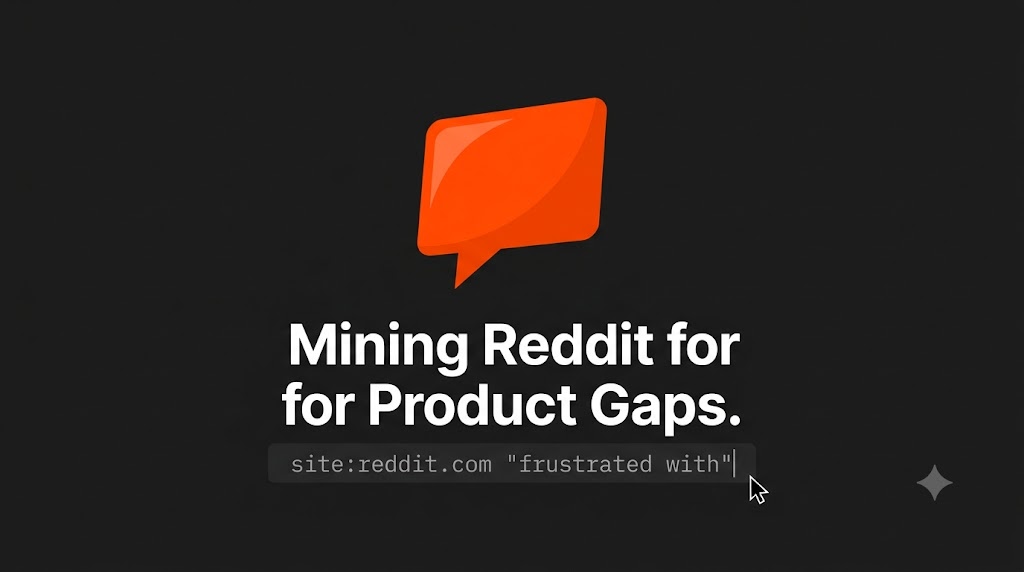
Type site:reddit.com "[your product category] complaints" or site:reddit.com "frustrated with [product name]" into Google. This method bypasses Reddit’s internal search limitations entirely and surfaces older, high-quality discussions that Reddit’s own search often buries. Google’s indexing of Reddit is comprehensive. Threads from three years ago that are still getting engagement, threads with hundreds of comments, deep product teardowns: these all surface via Google in ways Reddit’s own search does not.
The subreddits those threads appear in are your targets. Note them. Cross-reference with the sidebar chaining results and you will quickly build a reliable map.
Method 4: Reddit Pro Trends
Reddit launched Pro Trends in 2024, and expanded it significantly through 2025. It is a free tool within Reddit Pro that lets businesses track trending topics and discussions based on custom keywords, including which subreddits those conversations are growing in.
For product research specifically, set up keyword alerts around your product category, your competitors’ brand names, and common complaint phrases. The tool aggregates emerging discussions across the platform and identifies trend velocity, so you can see not just where complaints are happening but whether a particular frustration is growing.
A well-documented example of how this data works in practice: Reddit Pro Trends surfaced the surge in “Lululemon dupe” discussions in subreddits like r/Ulta and r/xxFitness well before TikTok creators amplified the trend into mainstream retail attention. For brands that were watching, that was months of advance notice about a genuine market shift.
Method 5: Competitor Brand Name Search
Search your main competitors’ product names directly in Reddit. Sort results by “Top” to surface the most-engaged threads. The subreddits where those threads appear are communities already discussing your category at a meaningful level.
This approach has a secondary benefit: the complaint threads you find about competitors are often the most specific and most actionable data you can get. Someone explaining in detail why they stopped using a competitor’s tool, what specifically broke down, and what they are now looking for, is essentially handing you a product positioning brief.
How to Extract Product Complaints Once You Find the Right Subreddits
Finding the subreddits is step one. Extracting signal from them is step two, and it requires a different approach than casual browsing.
Use Complaint-Specific Search Phrases
Inside any subreddit you have identified, use Reddit’s search to filter posts with specific phrases. These consistently surface high-value complaint threads:
- “frustrated with”
- “wish there was”
- “looking for an alternative”
- “does anyone else have this problem”
- “am I the only one”
- “why does [product] not”
- “switched from”
- “gave up on”
- “anyone else hate”
These phrases surface people actively seeking solutions, as opposed to casual discussion, which makes the insights far more actionable. The distinction matters because complaint threads where users describe what they tried, what failed, and what they need next contain structured product intelligence that general discussion threads do not.
Sort by “Top” Across Different Timeframes
Most people default to sorting by “Hot” or “New.” For research purposes, sorting by “Top” over specific windows gives you different types of data:
- Top / Past Week: What is the most energized complaint right now?
- Top / Past Month: What recurring frustrations have staying power?
- Top / All Time: What are the fundamental, unresolved problems in this category?
The “Top / All Time” view is particularly useful for identifying structural complaints that multiple products have failed to solve. A thread from two years ago with 800 upvotes and 300 comments, describing a problem that is still unresolved, is a product development brief hiding in plain sight.
Read the Comments, Not Just the Posts
The original post in a complaint thread is often the least informative part. The comments section is where the intelligence lives. Most valuable insights hide in discussions rather than original posts. Comments reveal:
- Which specific products users have already tried and abandoned
- What they considered acceptable versus unacceptable workarounds
- Whether the complaint is isolated or widely shared (“same issue here” or “had this exact problem”)
- What feature or solution would actually fix the problem, in the users’ own words
- Which competitor products come up as alternatives, and why those have their own complaints
The comment chains that branch off into product comparisons are especially useful. They often contain the clearest articulation of unmet needs you will find anywhere.
Track Recurring Phrases, Not Just Recurring Topics
The exact language people use to describe their complaints is as valuable as the complaints themselves. When similar complaints recur using similar phrases across multiple subreddits, those phrases often indicate real market gaps. More practically, they are the exact language your target audience uses to search for solutions, which means they are also the language your content and product positioning should use.
If three separate subreddits contain threads where users describe a software tool as “clunky” and “hard to export from,” that specific vocabulary is not just a complaint. It is a positioning opportunity for any competitor that nails simplicity and easy export, and it is the language those users are likely typing into Google and Perplexity when they start shopping for alternatives.
Building a Structured Research Framework
Ad-hoc Reddit browsing produces ad-hoc insights. To turn this into a repeatable intelligence process, you need a basic structure.
Set a specific research question before you start. Vague goals produce vague data. “Understand our audience” is not a research question. “Identify the three most common complaints about project management tools among freelancers” is. Specific questions lead to focused research, which leads to insights you can act on. Write the question down before opening Reddit.
Build a running tracker. A simple spreadsheet works. For each complaint thread you find, record: the subreddit, the post title, the approximate engagement level (upvotes and comment count), the core complaint in one sentence, any specific products mentioned, and any phrases that feel like genuine consumer language worth reusing. After fifteen to twenty threads, patterns emerge.
Analyze across subreddits, not within them. A single complaint thread is anecdote. The same complaint appearing in r/freelance, r/Entrepreneur, and r/digitalnomad is signal. Meaningful patterns only emerge when you analyze fifteen to twenty threads across multiple subreddits. Resist the temptation to draw conclusions from one powerful thread.
Test your assumptions against negative evidence. Search for “[your hypothesis] doesn’t work” or “why [your product category] is overrated.” Deliberately looking for threads that might disprove what you think you know is how you avoid confirmation bias, which is the most expensive mistake in consumer research.
A Practical Example: Running This Process for a SaaS Brand
Say you are a B2B SaaS company building a client reporting tool. Here is what the research process looks like in practice.
You start with Reddit’s native search: “client reporting software.” You find r/freelance, r/marketing, r/SEO, and r/PPC as relevant communities. You check each sidebar and add r/agency and r/digitalmarketing to the list.
You run Google searches: site:reddit.com "frustrated with client reporting" and site:reddit.com "client reports take too long". Several high-engagement threads appear. You note the subreddits.
Inside r/freelance, you search “wish my reporting tool” and find three threads in the past year with substantial engagement. The recurring complaint: building reports manually from multiple platforms takes hours every week, existing tools do not pull the right data automatically, and clients still ask for customizations that break the templates.
You check Top/All Time in r/agency. Two of the highest-voted threads are titled “How do you handle monthly client reports without losing your mind?” (from 2022, still getting comments) and “Honest opinions on [competitor tool] for client reporting.” The second thread contains 180 comments comparing four products, with specific feature-level complaints about each.
You now have: three structured complaint categories, the exact vocabulary users use to describe the problem, a list of competitor tools users have tried and rejected, the specific features that would make them switch, and the subreddits where this audience is active.
That entire process takes about two hours. What it produces would cost tens of thousands in a commissioned research project, and it would be less specific.
Turning Complaint Intelligence Into Community Presence
Finding where complaints live is one thing. Showing up in those conversations with something genuinely useful is another, and it is where most brands stumble badly.
The instinct is to post a solution or drop a product link. That almost always backfires. Reddit communities identify promotional intent quickly, and a brand account that shows up only when there is something to sell gets downvoted, reported, and eventually filtered out of the community entirely. This is not just a reputational problem. It means the research investment you just made produces no community dividend.
The alternative is participating through people who already belong to those communities, which is where Spredditor becomes relevant.
Spredditor’s network of verified, high-karma Redditors gives brands access to real community members who are already active in the subreddits your research identified. Instead of a brand account appearing in a complaint thread with an obvious product pitch, a genuine community member who already has standing in that space engages substantively with the discussion. They are not reading from a script. They are authentic Redditors with real participation histories, who happen to have experience with products that solve the problems being discussed.
This approach directly addresses the account repetition problem that gets most brands banned: because each Redditor has their own independent account history, karma, and community relationships, Reddit’s spam detection sees authentic distributed participation rather than coordinated promotional activity.
The intelligence you extracted in your research process becomes the briefing. The Redditors Spredditor connects you with bring the credibility. The combination produces something neither can deliver alone: a brand presence in the right subreddits that actually earns community trust.
Frequently Asked Questions
How often should I run Reddit complaint research?
For most brands, a structured research session every four to six weeks is enough to catch emerging complaints before they become mainstream problems. If you are in a fast-moving category (consumer tech, SaaS, skincare), monthly monitoring using Reddit Pro Trends alerts makes sense.
Is this approach useful for early-stage products or only established brands?
It is arguably most valuable for early-stage products. Finding the specific complaints that competitors have not solved is the fastest path to product-market fit. People freely discuss what breaks, what disappoints, what feels overpriced, and what genuinely improves their lives. For a founder choosing between two feature priorities, two hours on Reddit beats two weeks of customer interviews in terms of unfiltered signal.
What if my product category is not very active on Reddit?
Look upstream. If there is no active subreddit for your specific product type, there is almost certainly an active community organized around the problem your product solves, or the audience your product serves. A narrow B2B tool for accountants might not have its own subreddit, but r/accounting, r/taxpros, and r/smallbusiness collectively contain years of complaint data about the workflows your tool would improve.
How do I avoid reading biased or unrepresentative threads?
No single source is representative. The protection is volume: analyze fifteen or more threads across multiple subreddits before drawing conclusions. Look for phrases and complaints that recur independently, not just threads that say the same thing because they were written by the same frustrated user. Cross-reference what you find on Reddit against other sources (review sites, customer support tickets, sales call notes) to validate before acting.
Can I use AI tools to speed up the analysis?
Yes, and it helps significantly at scale. Tools like Reddily and PainOnSocial use AI to extract themes and sentiment patterns from batches of Reddit threads, collapsing hours of manual reading into faster structured outputs. That said, the search and subreddit discovery steps still benefit from manual judgment. AI tools are best used for analyzing threads once you have found the right communities, not for replacing the strategic thinking that identifies where to look.
What do I do with the complaint data once I have it?
At minimum: update your product positioning to address the unmet needs you identified, use the consumer language you found in your ad copy and landing pages, and share the insight clusters with your product team. At best: use Spredditor to deploy that intelligence into authentic community conversations, so that your brand is present in the exact discussions where buyers are forming their opinions.
The Bottom Line
Reddit’s complaint threads are the most honest, most detailed, most current, and most accessible source of consumer product intelligence available. The methodology is not complicated: find the right subreddits using the five methods above, search with complaint-specific phrases, sort by top posts across different timeframes, read the comments, and track recurring language across threads.
The hard part is not the research. It is doing something with what you find without triggering the community dynamics that get brands banned. That is the gap Spredditor fills: turning complaint intelligence into authentic community presence, through real Redditors who already belong to the spaces where your buyers are talking.
Your next product insight, your next positioning angle, your next campaign brief: it is already in a Reddit thread somewhere. The only question is whether you find it before your competitor does.
Sources:
- Sprout Social, Reddit Trends Analysis, Q3 2025 Consumer Pulse Survey
- Hootsuite Blog, Reddit Trends for Marketers, 2026
- Amra & Elma, Reddit Marketing Statistics, 2025
- Influencer Marketing Hub, Reddit as a Continuous Insight Machine, 2025
- Reddily, How to Use Reddit for Market Research, 2026
- Reddily, Best Subreddits for Market Research, 2026
- PainOnSocial, Best Market Research Tools for Reddit, 2025
- SellTheTrend, Using Reddit to Find Untapped Products, 2026
- ReddinBox, Reddit Market Research Practitioner’s Guide, 2026
- Wappkit/Reddit Toolbox, How to Find Subreddits, 2025
- SubredditSignals, Finding Subreddits for Your Business, 2025
- Enrich Labs, Reddit Trends 2025
- Spredditor.com, Platform Documentation, 2026
- eMarketer, Reddit AI Shopping Search and Dynamic Product Ads, 2026