How Do I Format My Website Content So AI Scrapers Actually Use It as a Source?
Key Takeaways
If you want AI search engines like ChatGPT, Gemini, Perplexity, and Google AI Overviews to use your website as a source, your content needs to be easy to crawl, easy to understand, and easy to cite.
Focus on these five things:
- Answer the main question clearly near the top
- Use simple, query-based headings
- Structure content with tables, FAQs, definitions, and examples
- Add credible sources, dates, author details, and schema markup
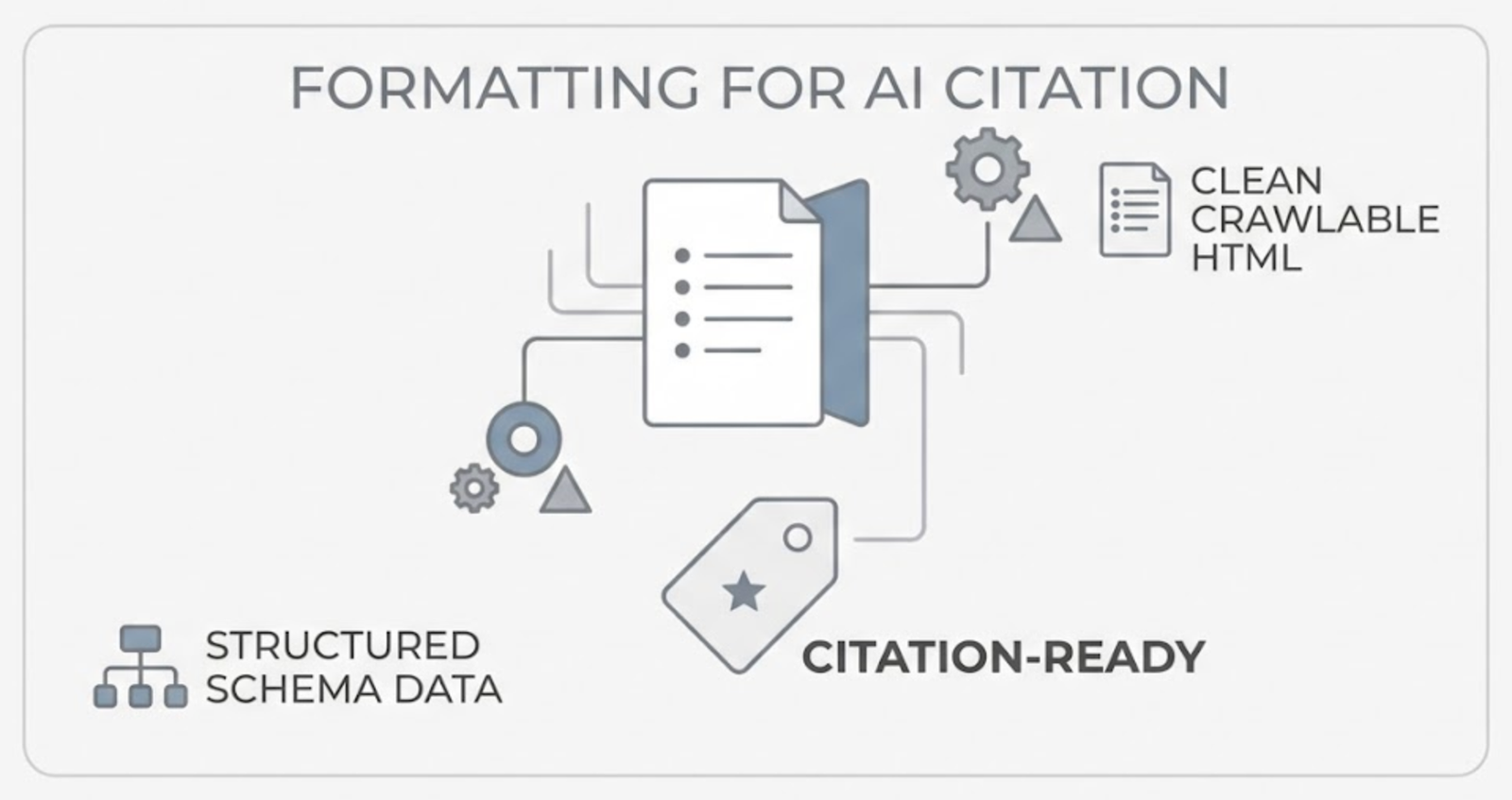
- Make sure important content is crawlable HTML, not hidden inside images, scripts, or PDFs
AI engines do not cite vague content. They cite clear, specific, well-structured content that helps them answer a user’s question quickly.
What does it mean to format content for AI scrapers?
Formatting content for AI scrapers means making your website easy for AI systems to read, extract, summarize, and cite.
This is different from traditional SEO.
SEO asks:
“Can this page rank on Google?”
AEO asks:
“Can this page answer a specific question?”
GEO asks:
“Can an AI engine trust and cite this page as a source?”
The best content today needs to do all three.
Start with the direct answer
Do not begin with a long introduction.
Most AI engines and users want the answer quickly. Put a clear answer within the first 100 to 150 words.
For example:
“To make website content usable by AI scrapers, use crawlable HTML, clear headings, direct answer blocks, structured data, original insights, and credible source references.”
That kind of sentence is easy for AI engines to extract.
Avoid openings like:
“In today’s fast-changing digital world, businesses must adapt to new technologies…”
That says nothing useful.
Use headings that match real questions
AI search is conversational. Your headings should sound like the questions people actually ask.
Instead of:
“Technical Optimization”
Use:
“Should I allow AI crawlers in robots.txt?”
Instead of:
“Content Strategy”
Use:
“How should I structure content for AI citations?”
Good headings help AI systems understand which section answers which query.
Use headings like:
- What is GEO?
- How do I make my content AI-readable?
- Does schema markup help AI citations?
- Should I create an llms.txt file?
- How do I know if AI tools are citing my website?
Make every section answer one clear question
Each section should have one job.
A strong section structure looks like this:
- Answer the question directly
- Explain why it matters
- Add an example
- Support it with a source, data point, or internal insight
Example:
“Schema markup helps search engines understand the entities on a page, such as the author, organization, article type, product, service, or FAQ. It does not guarantee AI citations, but it reduces ambiguity and makes your content easier to interpret.”
That is much stronger than saying:
“Schema is important for better visibility.”
Use tables wherever comparison is useful
AI engines often answer comparison-based queries. Tables make your content easier to extract.
Use tables for:
- SEO vs AEO vs GEO
- Product comparisons
- Service comparisons
- Pros and cons
- Pricing breakdowns
- Step-by-step checklists
- Tool comparisons
- Feature comparisons
Example:
| Element | Why it helps AI engines |
|---|---|
| Key takeaways | Gives a quick summary of the page |
| Direct answer | Helps AI extract the main response |
| FAQ section | Matches conversational search queries |
| Schema markup | Helps search engines understand the content |
| Original data | Gives AI a reason to cite you |
| Author and date | Builds trust and freshness |
Tables are especially useful because AI systems can understand and reuse structured comparisons more easily than long paragraphs.
Add original insights, not generic advice
This is where most websites fail.
AI tools do not need another article saying “create high-quality content.” That already exists everywhere.
To become citation-worthy, add something original.
Use:
- Internal data
- Customer research
- Case studies
- Expert commentary
- Benchmarks
- Screenshots
- Before and after examples
- Step-by-step processes
- Lessons from real client work
- Industry-specific observations
For example, instead of saying:
“AI visibility is important for SaaS brands.”
Say:
“In our monthly AI visibility tracking, SaaS brands tend to appear more often when their product is discussed across third-party comparison pages, Reddit threads, review sites, and detailed use-case content.”
That is specific. It sounds experienced. It gives AI systems something useful to cite.
Keep important content in crawlable HTML
Do not hide your best content inside:
- Images
- PDFs
- Videos
- Popups
- Tabs that require interaction
- JavaScript-heavy sections
- Gated pages
- Sliders
- Infographics without text support
If a key claim matters, it should appear as plain HTML text on the page.
For example, if your homepage says “trusted by 500+ SaaS companies” inside an image, add the same claim as text nearby.
AI systems cannot reliably cite what they cannot crawl.
Add schema markup
Schema helps search engines understand what your page is about.
For most content pages, use:
- Article schema
- Organization schema
- Person schema
- Breadcrumb schema
- FAQ schema, where relevant
For product or service pages, consider:
- Product schema
- Service schema
- Review schema, only if reviews are genuine and visible
- AggregateRating schema, only if policy-compliant
Schema will not make weak content rank or get cited. But it helps machines understand strong content more clearly.
Add trust signals on every important page
AI engines are more likely to trust pages that show clear ownership and credibility.
Add:
- Author name
- Author bio
- Company name
- Published date
- Last updated date
- Sources
- Methodology, where relevant
- Contact or editorial information
- Internal links to supporting pages
Avoid anonymous, undated articles if the topic requires trust.
For fast-changing topics like AI tools, software, pricing, legal rules, or search algorithms, update the page regularly and show what changed.
Example:
“Updated July 2026: Added guidance on AI crawlers, llms.txt, and schema markup for GEO.”
That is more credible than simply changing the date.
Allow the right crawlers
If you want your website to appear in AI search results, make sure you are not accidentally blocking important crawlers.
Review your robots.txt file for:
- Googlebot
- OAI-SearchBot
- GPTBot
- PerplexityBot
- Other relevant AI or search crawlers
Be careful with blanket blocks. Some bots are used for search discovery, while others may be related to model training. Treat them separately based on your policy.
If AI visibility is the goal, blocking every AI crawler can reduce your chances of being discovered or cited.
Create an llms.txt file
An llms.txt file is an emerging way to help AI systems understand the most important parts of your website.
It usually sits here:
yourdomain.com/llms.txt
Use it to list:
- What your company does
- Your main services or products
- Your most important guides
- Your case studies
- Your research pages
- Your documentation
- Contact or attribution notes
Think of it as a map for AI systems.
It will not fix poor content, but it can help AI tools understand your site structure faster.
Format service pages like source pages, not brochures
Most service pages are too vague.
They say things like:
- “We help brands scale”
- “We offer end-to-end solutions”
- “We combine creativity and data”
These lines are not useful for AI engines.
A better service page should clearly answer:
- Who is this service for?
- What problem does it solve?
- What is included?
- What is the process?
- What results are realistic?
- What inputs are needed?
- How long does it take?
- What makes the approach different?
- What examples support the claims?
The more specific your service page is, the more likely it is to be used as a source.
Use this AI-ready content checklist
Before publishing, check whether your page includes:
| Requirement | Done? |
|---|---|
| Main answer appears near the top | |
| Headings are written as real questions | |
| Each section answers one clear query | |
| Key claims are written in crawlable HTML | |
| Page includes tables or structured lists | |
| FAQ section answers real user questions | |
| Author and company details are visible | |
| Published and updated dates are visible | |
| Sources are linked where claims are made | |
| Schema markup is added | |
| Internal links support the topic | |
| Robots.txt does not block important crawlers | |
| Page includes original data, examples, or expert insight |
FAQ
How do I make my content AI-readable?
Use clear HTML text, direct answers, question-based headings, structured sections, schema markup, and credible sources. Avoid hiding important information inside images, PDFs, or scripts.
Does schema help AI engines cite my website?
Schema helps search engines understand your content, but it does not guarantee citations. It works best when the page itself is clear, useful, and trustworthy.
Should I write shorter content for AI search?
Not always. Write as much as needed to answer the topic properly. The key is structure. Long content can work well if it has clear sections, summaries, tables, and FAQs.
What is the biggest mistake brands make with GEO?
The biggest mistake is publishing generic content. AI engines are more likely to cite pages with specific answers, original insights, examples, and credible sources.
Should I block AI crawlers?
Not if AI visibility is your goal. Review crawlers carefully and decide which ones to allow based on whether they are used for search discovery, AI answers, or model training.
Final takeaway
AI engines cite content that reduces uncertainty.
If your page gives a clear answer, proves its claims, uses clean structure, and is easy to crawl, it has a much better chance of being used as a source.
Do not just write for rankings. Write so your page can become the answer.